AI-driven omnichannel attacks are coordinated social engineering campaigns that unfold across multiple channels, such as email, phone, and internal messaging, to guide a target toward a decision over time rather than relying on a single point of failure.
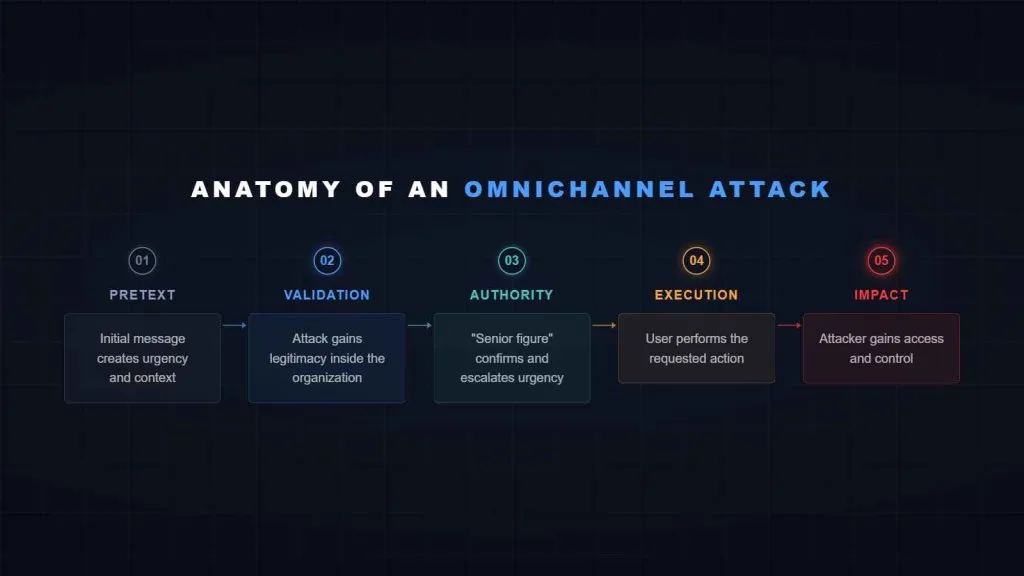
Picture this: a first request as a routine email.
A CFO asks for a quick review of a vendor payment. The tone is familiar, the timing plausible, and the request aligned with ongoing work. Nothing about it stands out enough to trigger suspicion.
A few minutes later, the phone rings. The same request, now reinforced with urgency. The voice matches expectations, the context holds, and any initial hesitation begins to fade. This is no longer just a message. It feels like a real interaction.
Then a message appears internally, on a trusted platform: a short follow-up asking whether the task has been completed. The same thread, now carried across another channel, closing the loop and applying pressure at the moment it matters most.
At no point does the attack depend on a single mistake. It unfolds as a sequence in which each step strengthens the credibility of the previous one and narrows the window for doubt.
This is the shift most security programs have not fully accounted for.
What was once categorized as phishing has evolved into something more structured and effective. A coordinated attack path designed not to deceive once, but to guide a decision over time.
The Evolution of Social Engineering
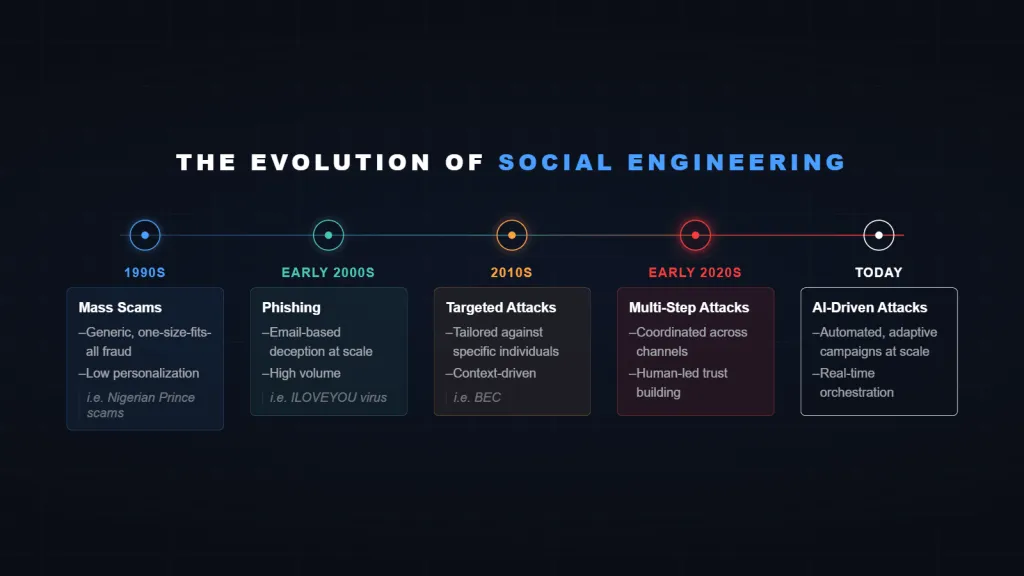
Social engineering has not changed in intent, but it has changed in execution. The evolution is best understood visually in the framework below: from high-volume, low-context scams, to targeted attacks, and now to orchestrated, multi-step AI CyberAttacks that unfold across channels.
What matters is the shift in the model. Attacks no longer rely on a single interaction but on a coordinated progression in which each step reinforces the next. This is the foundation of omnichannel social engineering, where effectiveness comes from narrative consistency rather than any individual message.
The Role of AI in Social Engineering
Artificial intelligence does not introduce fundamentally new attack types, but it changes the economics and execution of existing ones.
Impersonation, for example, is no longer constrained by writing ability or familiarity with corporate tone. AI enables attackers to generate highly realistic communications tailored to specific roles, geographies, and business contexts. More critically, it extends impersonation into voice, allowing attackers to replicate executives or trusted contacts in real time, reducing one of the last barriers to convincing interaction.
Phishing content has undergone a similar transformation. Instead of relying on static templates, attackers can now generate context-aware messages that reflect ongoing projects, organizational structure, and current events. This removes the inconsistencies that traditionally exposed malicious intent and makes detection through superficial cues far less reliable.
The most significant impact, however, is in coordination.
AI enables attackers to orchestrate multi-step campaigns with a level of speed and adaptability that was previously impractical. Timing can be adjusted dynamically, channels can be switched seamlessly, and responses can be incorporated into the flow of the attack. What once required manual effort and careful planning can now be executed as a continuous, adaptive process.
At the same time, the attack surface continues to expand. The adoption of unsanctioned AI tools introduces new blind spots, while business processes themselves become targets. Approval workflows, financial procedures, and internal communication patterns provide structure that attackers can exploit without directly compromising systems.
The result is not simply more sophisticated attacks, but more cohesive ones. AI removes friction, allowing attackers to focus on designing interactions that feel legitimate across an entire sequence rather than optimizing a single touchpoint.
Why These Attacks Work
Traditional security models are built around identifying anomalies within individual events. A suspicious link, an unusual sender, or a malicious attachment provides a clear signal that something is wrong.
Omnichannel attacks deliberately avoid relying on these signals.
There may be no malicious link, no obvious spoofing, and no single interaction that appears sufficiently suspicious on its own. Each component of the attack is designed to fall within the bounds of normal activity, making detection through isolated analysis ineffective.
The vulnerability lies in how decisions are made. Users do not evaluate interactions in isolation. They interpret them as part of an ongoing context, where multiple signals combine to form a coherent picture. When these signals are consistent, even if each is relatively weak, they create a strong sense of legitimacy.
Time pressure further complicates this process. Decisions are often made in motion, without the opportunity to step back and assess the full sequence. The attacker’s objective is not to create a perfect deception, but to maintain enough consistency to carry the interaction forward until the decision point is reached.
In this sense, the attack exploits a structural gap rather than a specific failure. It leverages the fact that while security controls are applied at the level of individual events, human decision-making operates across sequences.
Where Security Programs Break
Most security programs are still built around discrete control points. Email security scans messages, endpoint tools monitor devices, and training teaches users to spot known indicators. Each layer works in isolation, but none are designed to operate across channels.
This creates fragmentation. An email is assessed separately from a call, which is disconnected from an internal message. The sequence is never evaluated as a whole, so the context that makes the attack effective is lost.
Training follows the same pattern. Employees learn to recognize suspicious signals, but not how to question a coherent narrative. In omnichannel attacks, that distinction matters.
When risk is distributed across steps, the absence of a clear red flag does not mean safety. It reflects a different strategy. Security programs are built for events. Attacks are built as sequences.
What Needs to Change
Addressing omnichannel threats requires a shift in both training and measurement.
Training must reflect how attacks unfold, exposing employees to sequences rather than isolated interactions. The goal is not just recognition, but the ability to question a coherent narrative under pressure. Decision-making becomes central. Employees need to pause, verify, and escalate even when nothing appears obviously wrong.
Simulation is critical to build this instinct. Without experiencing realistic attack flows, it is difficult to understand how convincing these sequences can be, and many programs are unable to truly simulate attacks ike vishing. Measurement must follow the same shift. Click rates and completion metrics are insufficient. What matters is behavior across the sequence.
This is the essence of Human Risk Management: moving from knowledge to behavior, and from isolated metrics to real-world outcomes.
Where Right-Hand Fits
Omnichannel attacks expose a gap traditional tools are not built to close. Addressing it requires connecting signals, behavior, and intervention into a continuous loop.
Right-Hand’s Human Risk Management platform integrates with existing security tools to capture user-generated risk signals and respond in real time. Powered by a fleet of AI-driven agents, it continuously adapts to user behavior, orchestrates simulations, and delivers contextual interventions.
Instead of separating phishing, vishing, and training, it simulates coordinated attack flows, observes behavior across sequences, and acts in the moment to influence decisions.
This gives teams visibility into real decision-making. By linking alerts to targeted coaching, organizations can reduce risky behavior and, over time, lower user-driven security alerts.
The goal is not to replace controls, but to connect them through the human layer, where these attacks succeed or fail.
As attacks become coordinated, the challenge shifts from detecting a message to understanding and influencing the sequence.
Request a demo to see how this works in practice.