Masaaki Taira, head of Japan's National Cybersecurity Strategy Headquarters, has called the situation an "emergency in cyberspace." The Financial Times counts more than 20 major companies reporting attacks in recent weeks, Lawson and Times Car among them. JR East says it can't rule out that email addresses for up to 1.67 million Eki-net members were accessed or taken from its booking service. By TrendAI's count, Japan had 600 publicly disclosed incidents from January through September 2026, already past the 593 it counted for all of 2025.
If you run security in Japan, or anywhere your language used to slow attackers down, you're deciding right now where your money and your team's time go next. I'd put human risk at the center of that decision. As AI perfects the technical execution of attacks, the frontline is moving from software to human psychology and behavior.
Key Takeaways
- TrendAI recorded 600 publicly disclosed cybersecurity incidents in Japan from January through September 2026, surpassing the 593 total incidents counted for all of 2025.
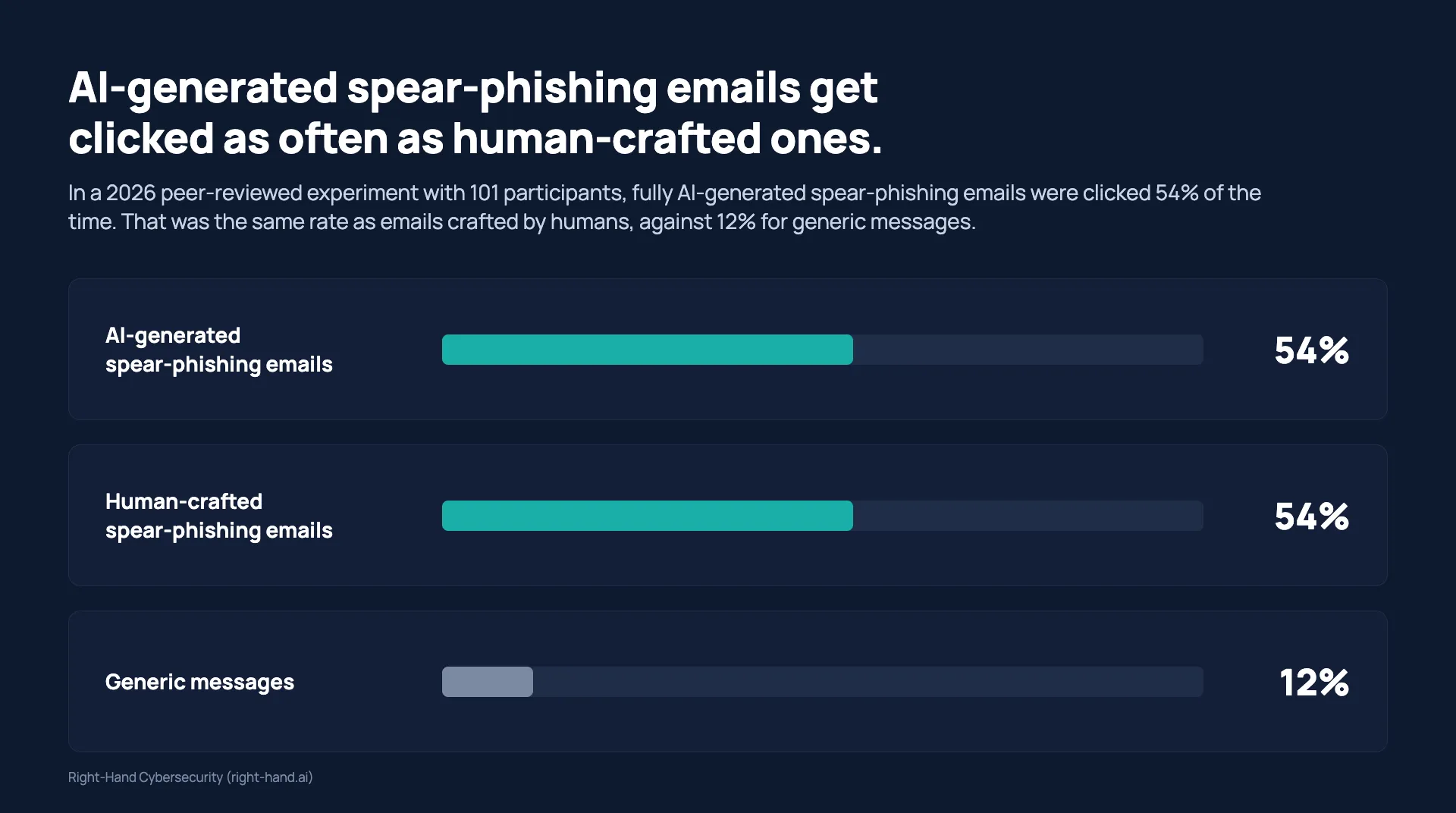
- A 2026 peer-reviewed experiment demonstrated that AI-generated spear-phishing emails achieved a 54% click rate compared to 12% for generic one-size-fits-all messages.
- AI tools allow cybercriminals to bypass Japanese language barriers and eliminate the unnatural phrasing that previously served as a primary marker for identifying phishing attempts.
- Attackers leverage AI alongside stolen customer data from breaches like the 2.15-million-record Lawson ID leak to automate millions of individualized spear-phishing messages.
- Hackers exploited a password vulnerability in site network equipment to shut down 30 Asahi Group Holdings factories during a 2025 cyberattack.
- Right-Hand Cybersecurity combats executive impersonation using a pause, verify, and act framework that requires employees to independently confirm urgent payment requests through separate channels.
- Security Operations Centers should track actual behavioral violations because phishing simulation scores artificially fluctuate based on the detection difficulty of the specific testing template.
How Does AI Help Hackers Bypass Japanese Language Barriers in Phishing Attacks?
Nobuo Miwa, president of Tokyo-based S&J Corp, compared the recent attacks to "carpet bombing" in a statement to Reuters. He also suggested AI tools may be helping foreign hackers get past the language barriers that used to make Japanese firms harder to attack. When that barrier disappears, the first thing that happens is that uncertainty increases, right? The old rules do not apply. Your legacy infrastructure is simply not enough, the cost of catching up is bigger, and the catching up itself is more complex.
Ten years ago, even five years ago, identifying a phishing email was a sure thing. Today, attackers use actual legitimate email addresses, along with language and approaches your current infrastructure doesn't cover. People manipulation can be grammatically perfect, can have the right sender, and still create a severe data breach.
A lot of awareness training still teaches markers: typos, odd wording, strange sender addresses. For Japanese companies, unnatural Japanese worked as a marker too. So I'd move the training from markers to context. Does this request make sense, coming from this person, through this channel, at this moment? That question still works on a deepfake voice call, or on an attack that jumps from email to phone, where there's nothing to proofread.
How Does AI Enable Cybercriminals to Scale Individualized Spear-Phishing Attacks?
Masaki Hiraoka, managing director for north-east Asia at Blackpanda, acknowledged to the FT that the recent attacks haven't been explicitly linked to AI. TrendAI says it hasn't established that connection either. Hiraoka's argument is that the technology lets hackers carry out attacks that once required time-consuming investigation ahead of time. "Smaller services that previously weren't worth the effort could become viable targets," he said. I'd take that logic down to every single record in a stolen database.
It's all about volume, right? Lawson has confirmed a leak affecting 2,155,345 Lawson ID accounts, including names and email addresses. In the old days, a list like that meant a single message made for everyone on it. One-size-fits-all messaging resonates with some customers and not with others. So the attacker took a big loss of efficiency, and a loss of efficiency on the attacker's side is a good thing for the rest of us. Now, with customer data, their emails and AI, an attacker can craft individualized messages that resonate one-on-one. That means potentially a million different messages to a million different people.
In a 2026 peer-reviewed experiment with 101 participants, fully AI-generated spear-phishing emails were clicked 54% of the time. That was the same rate as emails crafted by humans, against 12% for generic messages. The study is small and controlled, so it won't predict your own click rate. Still, the gap between 12% and 54% is what the one-size-fits-all message used to cost an attacker, and the AI emails closed all of it.
Bring it to online shopping. If I have your shopping data, I can craft a message that mentions a specific purchase. You bought whey protein powder last month, and now I have it on sale at 20% off. It's too good to be true, but it resonates, because it's something you're definitely interested in. The corporate version weaponizes something your company bought. You ordered toners last month, and if you fill in this form, your company gets a 50% discount over the next three orders. You deliver your data because it resonates, it makes sense, and it knows what you did and uses that against you.
Attackers today are looking for credentials. With a password in hand, they still have to get past your secondary defenses, and they often do it with fake MFA requests that count on someone approving one by mistake.
Why Must Cybersecurity Teams Balance Strict Technical Defenses with Human Behavioral Training?
Put all of that together, and security teams have to calibrate their technical defenses to attacks that keep getting more sophisticated and more lifelike. That means choosing between exposing users and hurting their productivity. In an emergency the pull is toward maximum strictness, and I compare overly strict filters to dropping a highway's speed limit to 10 mph. Incidents drop drastically, and so does the traffic. False positives pile up, operations stall, and your SOC spends its hours on alerts that were never threats.
The other pull is to buy another tool. It's easier to program software than to change human behavior, and stacking technological solutions is always a shortcut. I see it as a race towards zero, because leaders are just stacking software that gives them signals but doesn't give them the solutions. Buying more software will never fix a human vulnerability. Every layer you add brings more false positives for the SOC and more friction for the business, and it still doesn't fully stop sophisticated threats.
Asahi Group Holdings is a reminder that the technology still has its own job. The company's investigation found the attackers entered through site network equipment about 10 days before the September 29, 2025 disruption. They then exploited a password vulnerability to gain administrative privileges. Most of its 30 domestic factories shut down, and orders and shipments were handled manually until logistics systems resumed in December. Closing that kind of entry point is the technology's work. I see the whole defense as tech and trained people together, each covering what the other can't.
For email, that means calibrating your security tools to a baseline plateau. Tech works on parameters, and modern social engineering knows how to bypass parameters and fool people. Whatever gets past the filter has to meet your employees' well-trained common sense, and that common sense is what judges the context. I also advise CISOs against changing filter strictness for seasonal events. Intensify awareness training in high-pressure periods instead, like the end of the fiscal year (March, for many Japanese companies). Those are the weeks when tight deadlines make people more susceptible to impersonation and urgent requests.
How Does the Pause, Verify, and Act Framework Prevent Executive Impersonation Attacks?
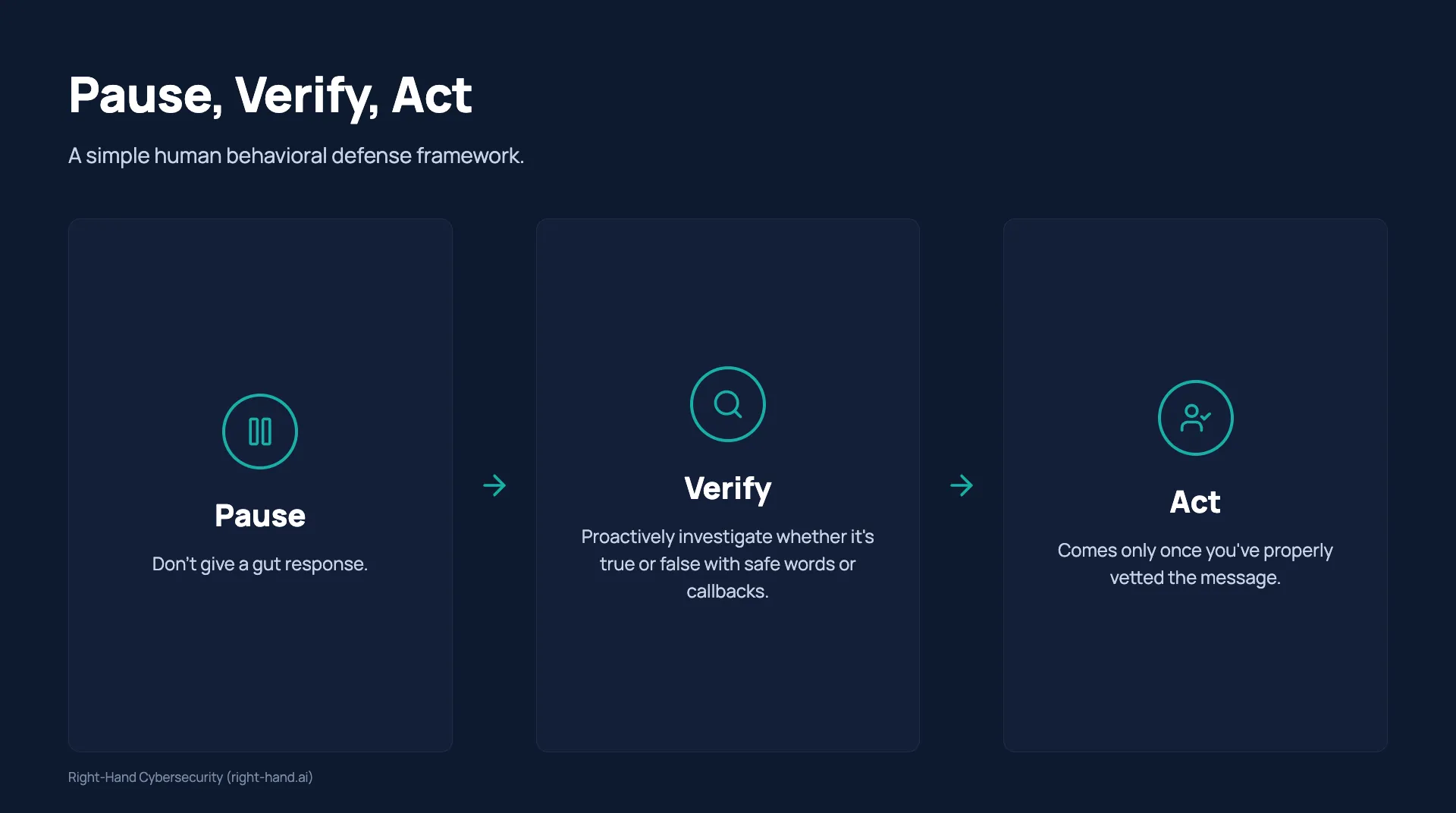
My first lesson in a training session would be pause, verify, and act. Pause means you don't give a gut response, so you don't take a request at face value. Verify means proactively investigating whether it's true or false. You do that with devices, and by devices I mean solutions, like safe words and internal passwords. Act comes only once you've stopped to think and properly vetted the message you received. At Right-Hand Cybersecurity, it's the framework we use to train employees against executive impersonation and artificial urgency.
Take a finance clerk who gets a perfectly written message from the "CFO" asking for a quick change to a payment. The first instinct is usually to answer as fast as possible, because it's the CFO, it's the boss. Stop and check before you comply, and if it's unusual, that goes double. That matters most when the request involves private data, moving money or payment authorizations. Get out of this cycle, you and the message, and go around that cycle. Go straight to the person asking and say, "Hey, I got this request from you. I'm just verifying."
The FBI's guidance on payment requests points the same way: verify through a phone number you got independently, never one supplied in the request. If the request came in as a call, hang up and call the executive directly, and act only when you're certain. Sometimes the clerk can't reach the CFO and a day goes by. If no one follows up on the original request in that time, it was never urgent, or it was never real.
One system I feel organizations could apply, and it's being talked about more and more lately, is a department safe word. Say I'm your leader and the password for this week is "bananas." If I say bananas during a request, by voice or by email, you know it's legit. You can make it more corporate, even a string of words, as long as it leaves a watermark that says, it is me and I'm making this request. A cloned voice can copy your CFO's tone, but it can't produce a word nobody gave it. The weak point is a person giving it away. NIST warns that shared secrets can leak through social engineering, so the safe word works as a second check on top of the callback.
Why Is Empowering Employees to Verify Executive Requests Critical for Cybersecurity Culture?
Middle and upper management, finance teams and executive personal assistants are the people attackers want most, because they hold the access keys to critical internal data. Attackers often go after them by impersonating IT, with deepfake audio or fake QR codes. When the request looks like it comes from an executive, as in the CFO case, pausing to verify means questioning someone senior. In a work culture like Japan's, pushing back on a boss can feel disrespectful, so that pause can feel risky. It's all about corporate culture. If the company stimulates the behavior of asking for confirmation, that can override the customs of the country or region.
So the company has to lead the way and say it's okay to question, because the risk is too big for us not to. Of course, the questioning is selective, aimed at what makes sense to check and what could be risky. The push also has to reach leaders as much as employees. Management goes through the same training as everyone else. A leader who gets a verification call has to understand the power of stopping and verifying, and back the person who made it.
Why Should Security Operations Centers Track Actual Behavioral Violations Instead of Phishing Simulation Scores?
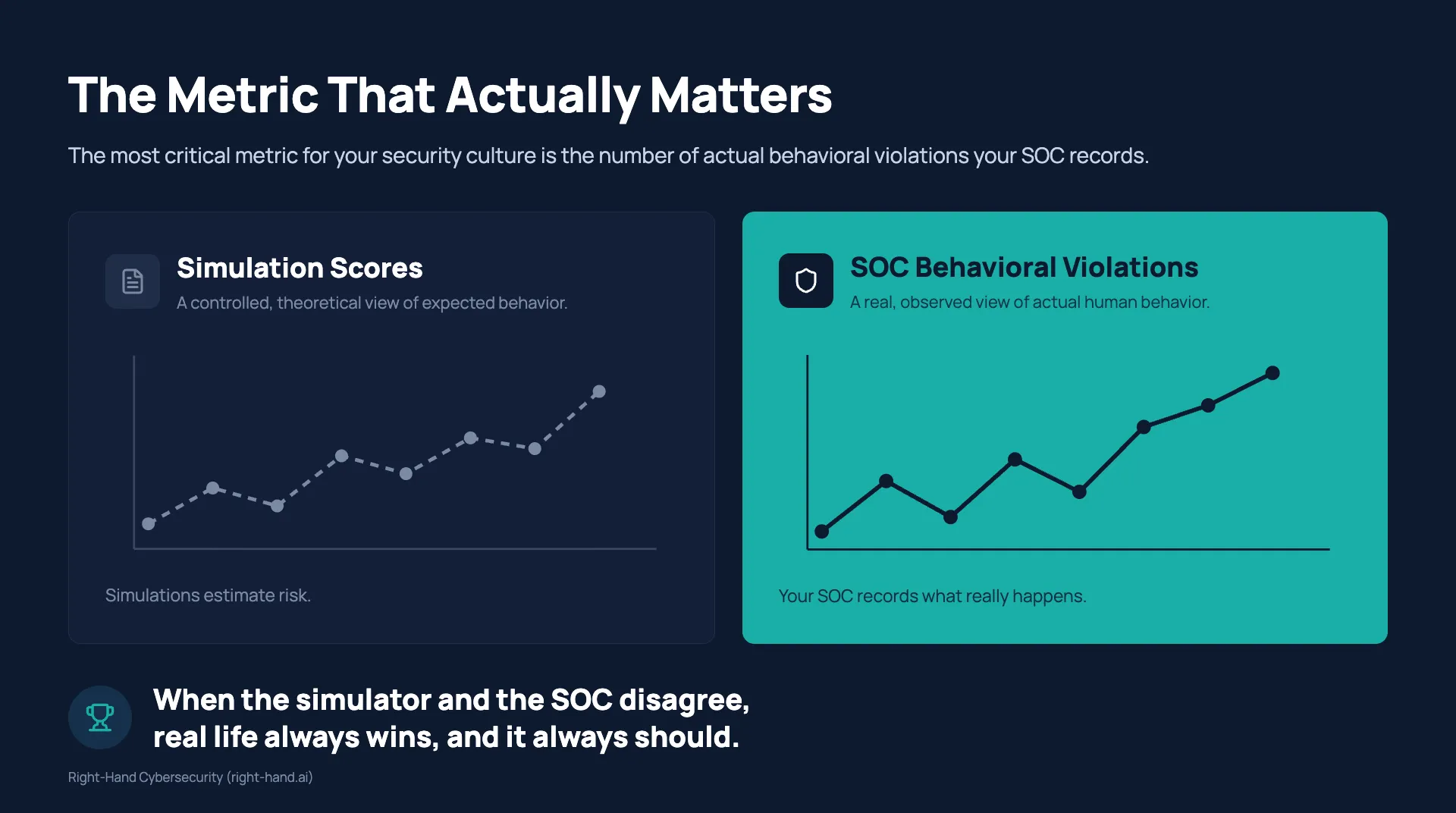
Completion rates won't tell you whether any of this is working, and simulation scores have their own problem. NIST points out that click rates vary with detection difficulty for a given audience, including how well a message's premise fits people's work. A better score this quarter can simply mean an easier template. The most critical metric for your security culture is the number of actual behavioral violations your SOC records. Establish a baseline and a benchmark for every type of risky behavior across all departments, and you have numbers you can track over time and show the board. When the simulator and the SOC disagree, real life always wins, and it always should.
For the training itself, I advocate a two-headed approach: training based on behavior, but also training based on performance. Simulated phishing builds the theoretical knowledge. Targeted lessons go out when your security stack detects a real risky behavior. The employee who just did something risky gets a lesson tied to that exact action, built on a real signal from your own environment.
Employee reporting belongs next to those numbers. At Right-Hand Cybersecurity, we've helped multiple customers build a proactive security culture, and the result has been a measurable surge in employees reporting potential threats. More reports can mean more safe items flagged by mistake, and I still read that surge as a sign of a healthy security culture.
How Does the Pause, Verify, and Act Framework Protect Personal Inboxes from Phishing?
The Lawson accounts and the Eki-net addresses belong to people, and some of those people may work for you. The whey protein message lands in a personal inbox. So do the fake shipping notices and urgent promotions that pile up around a shopping season like Black Friday. The anxiety and frenzy of those weeks create mental blind spots, because any urgent request bypasses the mental blocks we have on regular days of the year. The rules in the real world are the same as in the corporate world, so I'd teach pause, verify, and act as one habit for both.
For a CISO in Japan right now, those lists are already out, and the next message built from them can arrive in flawless Japanese. I'd keep the email filters at their baseline. I'd put the next round of budget into what a finance clerk, an executive assistant or a Lawson shopper does in the minute after that message lands. Your SOC's violation numbers will tell you whether that's changing.
Frequently Asked Questions
How do VPN and remote desktop vulnerabilities compound human risk in ransomware attacks?
While phishing is rampant, technical flaws remain prime entryways. A recent National Police Agency survey of ransomware victims found 55% were breached via VPNs and 31% through remote desktops. Human risk training must tightly complement rigorous patching and access controls, acting as the final safety net when perimeter technology inevitably fails.
Why isn't multi-factor authentication (MFA) enough to stop AI-driven credential theft?
MFA is critical, blocking over 99% of unauthorized access attempts, according to Microsoft. However, sophisticated attackers now bypass this using MFA fatigue or AI-generated prompts, expecting users to mistakenly approve them. Technology alone won't fix a human vulnerability. You must actively train employees to pause, verify, and scrutinize anomalous authentication requests in real-time.
How do real-time behavioral interventions reduce SOC alert fatigue?
Overly strict technical filters drop business productivity, while legacy annual training leaves persistent vulnerabilities that flood the SOC with preventable incidents. By delivering automated, targeted micro-lessons the exact moment an employee commits a risky action, CISOs can measurably change behavior, dropping incident volumes and freeing analysts to hunt actual threats.
Why does the shift to double extortion ransomware make human risk management urgent?
Japan's National Police Agency noted that 82.8% of identified ransomware demands in 2024 involved double extortion — stealing data before encrypting it. Because attackers actively exfiltrate sensitive IP, post-breach technical containment is no longer sufficient. Stopping the initial human compromise through behavioral training is your best defense against catastrophic data exposure.
What is the most secure method for verifying urgent executive payment requests?
While internal safe words are sometimes discussed, NIST warns that shared secrets can leak via social engineering. The absolute best practice, aligned with FBI guidance, is verifying through a completely independent channel. If you receive an urgent emailed payment request, halt the transaction and call the executive directly at a known number.