Revolut's legal team did nothing wrong. They received a lawful request from a genuine government account and fulfilled it, which is the entire reason that team exists.
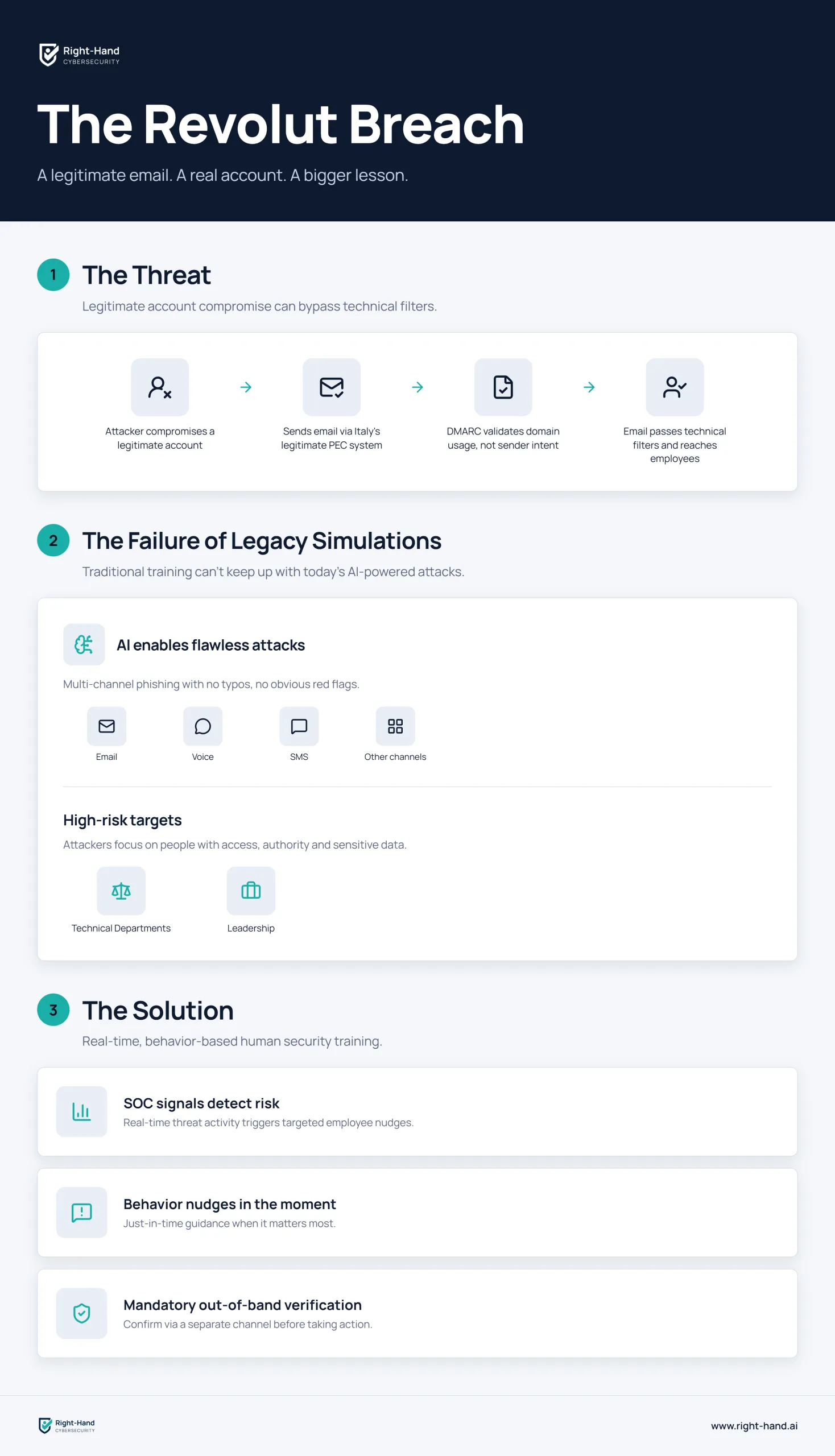
A demand for customer data, routed to the very team whose job is answering it, arriving through Italy's certified email system, is invisible to every tool built to catch an intrusion.
Every filter confirmed the message was authentic, because it was. A machine can verify a sender. It can never know the request is a lie.
Key Takeaways
- Email security filters failed to prevent the Revolut data breach because the malicious data request arrived through Italy's certified email system, passing all domain authentication checks.
- The NIST Phish Scale indicates that strong role-based alignment, such as sending a malicious data request directly to a corporate legal team, significantly reduces an employee's ability to detect phishing.
- An ETH Zurich field study of 14,000 employees revealed that embedded training following simulated phishing exercises fails to increase employee resilience against real-world social engineering attacks.
- A NIST survey revealed that 84% of security awareness practitioners evaluate corporate security culture by tracking training completion rates, while only 41% measure actual security incident trends.
- The FBI's 2024 IC3 report documented 17,367 government impersonation complaints resulting in $405.6 million in losses, illustrating the financial impact of authority-based social engineering.
- According to Verizon's 2026 DBIR, fake texts and voice calls achieve a 40% higher success rate than email phishing, requiring strict out-of-band verification procedures for external requests.
- Security Operations Center signals tracking actual risky employee behaviors, such as accessing dangerous websites, should trigger real-time educational interventions rather than relying on annual compliance videos.
Why Are Compromised Legitimate Senders More Dangerous Than Spoofed Emails in Cybersecurity?
The domain was genuine. The authentication checks passed. Every layer built to catch a spoofed sender saw nothing wrong, because there was nothing wrong to see.
Many leaders forget what email authentication actually proves. The DMARC standard itself says its checks validate use of a domain and do not assert that the sender is trustworthy. Here, that was the whole problem.
It gets worse. The account was part of PEC, Italy's certified email system for official communications. The regulator said the incident exposed weaknesses in the PEC system. The most trusted channel in the country became the delivery vehicle.
A great email security tool will not catch this email. The old red flags are gone too. With AI, there are no more grammar mistakes. Impersonating an official is super easy now, in text, in voice, in video. And attacks are multi-channel. If you suspect the email, a video message follows. If you doubt the video, the phone rings.
So what does marker-based training give an employee in that moment? Nothing. The markers are clean. The one defense left is the ability to look at a request and ask whether it makes sense. We need to start training employees for context and not just for markers.
Why Does Email Security Software Fail to Prevent Business Email Compromise Attacks?
I understand why the first instinct is to buy another tool. It's easier to program a software than changing human behavior.
But this is a race towards zero. Leaders are stacking software that gives them signals but does not give them solutions. There are so many guardrails that people can't do their jobs properly, and the business starts working around security.
Email security is the clearest example. Fine-tune those tools to perfection and you start blocking good emails from vendors, customers, and regulators. So you set your email security to a certain plateau. Then you let people's good sense make the rest of the decisions.
Keep the stack, though. Verizon's 2026 DBIR found that 31% of breaches began with software vulnerabilities. That put them ahead of stolen credentials as the top entry point for the first time in 19 years. Patch. Keep the gateway. The tools have a job. They just cannot do the human part of it.
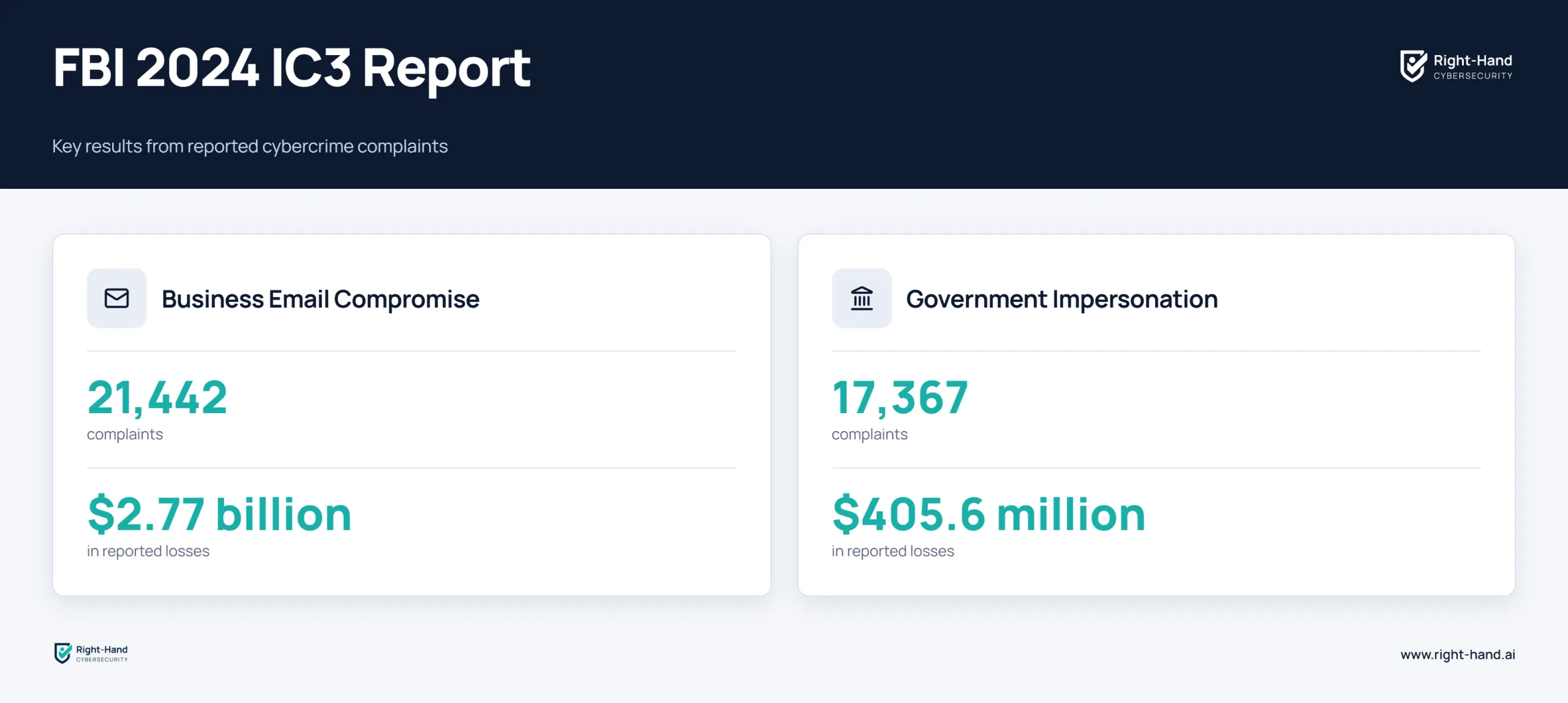
Social engineering targets people, and it remains the best attack vector any hacker has, especially with AI clones and AI script writing. The FBI's 2024 IC3 report logged 21,442 business email compromise complaints and $2.77 billion in reported losses. Government impersonation added 17,367 complaints and another $405.6 million. And those are just reported U.S. cases.
Your investment in tooling is worth zero if the people behind it are not trained for what gets through. Buying more software will never fix a human vulnerability, much less now.
What Contextual Warning Signs Indicate a Social Engineering Attack in Role-Based Phishing?
After the fact, experts pointed out the clues. The request came from an office that doesn't normally issue these orders.
That is a context clue. No filter catches it. Only a person who knows how legal requests normally arrive, and from whom, would pause on it.
NIST's Phish Scale rates a phishing email on two things: the visible cues, and how well the premise fits the recipient's role. It warns that strong role-based alignment makes an email harder to detect. A data request sent to the team that handles data requests is about as aligned as it gets.
How Can Out-of-Band Verification Prevent Role-Based Executive Phishing Attacks?
Could the right training have helped someone spot the clue? I believe so, if the training was built around context. Here is the pattern I use. Your CFO has never called you. Then one day the CFO calls asking for essential numbers from the company. That is a weird request. It has never been made to you before. You have to push back. You have to double check. You have to do a firsthand check instead of interacting with the call itself.
The same logic applies to Revolut's legal team. A request from an office that never sends them should trigger a check outside the channel it arrived on. The FBI says the same: verify sensitive requests using contact information obtained independently, never the number or address inside the request.
We see the opposite constantly with customers and prospects. It has become a cliche: employees trained to spot a wrong domain or bad grammar get tricked by an AI voice-generated call. That training is bound to fail.
Which Organizational Departments Are Most Vulnerable to Social Engineering Attacks?
The Revolut attacker targeted the team legally required to respond to these requests. That team's whole function is built around answering.
Research backs this up. A NIST study looked at 4.5 years of phishing exercise data from about 70 government employees. It found that people read email cues through their work context. The ones who clicked were worried about the consequences of failing to respond. That describes a legal team on a deadline perfectly.
When I get asked which department is the easiest target, I don't think it's a department per se. Middle to upper management are very susceptible, because those roles hold the keys to internal data. If a manager receives a fake MFA prompt and responds to it, attackers can get full access. Your upper managers all access the same CRM, whatever their department. Whoever responds becomes the vector.
Harden that side too. CISA recommends phishing-resistant MFA as the standard to aim for. Fix the prompt, and train the person who receives it.
Some functions are simply more valuable. IT people fall for social engineering sometimes. Finance teams. Personal assistants with access to C-level accounts.
Why Is Behavior-Based Security Awareness Training More Effective Than Phishing Simulations?
Here is my biggest problem with legacy security awareness training. It trains for hypothetical situations. A simulated phish, a quiz, a video once a year. Then the real world shows up looking nothing like the simulation.
The evidence on simulations is weak. A 15-month field study followed more than 14,000 employees. It found that embedded training after simulated phishing did not make them more resilient, and it had side effects nobody expected. Another experiment across 670 small and mid-sized businesses found that phishing drills cut clicking only in the short term. The simulation is the wrong trigger.
A modern program has to train based on real behavior. If you click on an email you should not have clicked on, that event becomes the context for follow-up training. This is a real signal. This is not a simulation.
How Can Security Operations Center Signals Trigger Real-Time Security Awareness Nudges?
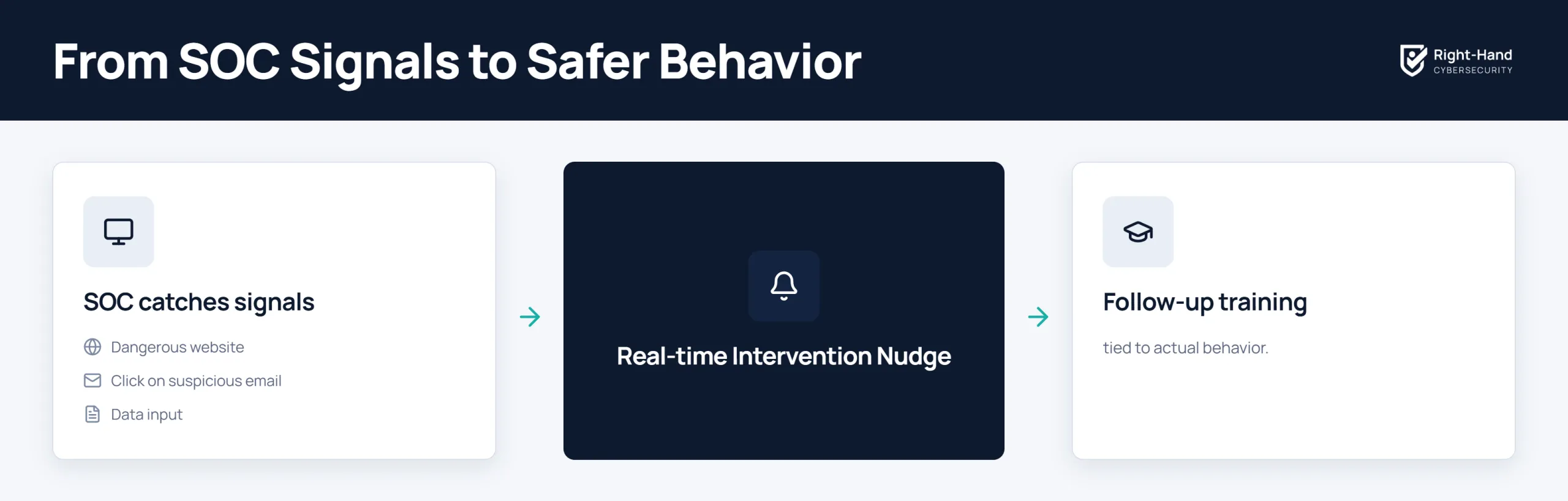
The infrastructure already exists in most organizations. Your SOC catches the signals every day. Access to a dangerous website. A click on a suspicious real email. Data typed somewhere it should not go.
The missing piece is tying those signals to nudges. You accessed this website, and it is dangerous, here is why. You are inputting data into a place you shouldn't be. The message reaches the person as a lesson in the moment. A nudge alone does very little, though. It has to be followed up with training tied to what the person actually did.
This is what we build at Right-Hand. We take the signals your SOC already collects and connect them to real-time interventions. It runs on top of the email and security tools you already have.
I'm always talking about training based on behavior, but also training based on performance. Quiz results still count. What the person actually did counts more.
What Are the Most Important Cybersecurity Behavior Metrics to Report to a Corporate Board?
Most boards still judge security culture by training completion rates. Ninety-something percent finished the video, so the slide looks great.
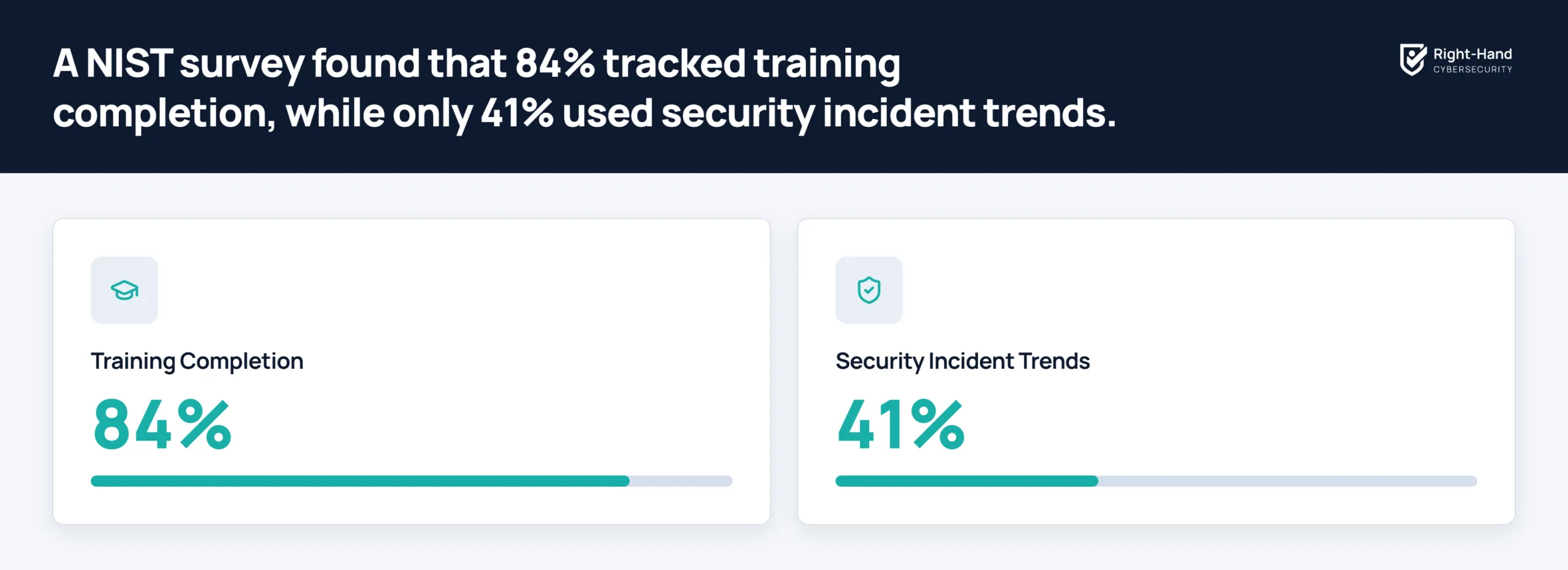
A NIST survey of security awareness practitioners found that 84% tracked training completion, while only 41% used security incident trends. Most of them called incident data valuable. Fewer actually used it.
I believe the killer number is on the SOC. Number of violations. Actual behavior. How many people incurred in risky behavior this quarter, and which kinds? Set benchmarks for every type of risky behavior in every department. Those are the numbers you want to see going down.
Simulation numbers and training scores still have a role. They create baselines, and they compound with the real-life behavior numbers. But real life always wins. Always should win.
Why Is an Increase in Employee Phishing Reporting a Positive Cybersecurity Behavior Metric?
Several of our customers have experienced a surge in employee-driven reporting. Sometimes the reported email is perfectly safe. I count that as a win. A healthy security culture makes employees proactive, and just by being proactive they are closing the door on several threats already.
The same ETH Zurich study found that employee reporting could help detect new campaigns at an acceptable operational load. For your SOC, every risky behavior that becomes a lesson is one fewer preventable incident to chase next quarter.
How Will AI-Driven Multi-Channel Phishing Attacks Evolve by 2027?
Now add what is already in the hacker's arsenal. The same fake request arrives from the same legitimate account. When the analyst hesitates, a call comes in from that office, in a voice that sounds exactly like a real official. If doubt remains, a short video follows.
The channel switch is the dangerous part. Verizon's 2026 DBIR found that fake texts and voice calls had a 40% higher success rate than email phishing. AI clone or a live voice, the calls are getting better. The defense stays the same. Hang up. Call back on a number you already trust.
How Can Organizations Implement Out-of-Band Verification for External Data Requests?
Identify the teams whose jobs obligate them to respond to outside requests: legal, compliance, finance, HR, support. Give them a verification step outside the channel the request came in on, and write it into the procedure. Pausing to verify then becomes what the process says to do.
Then make sure the people above them will back it. It's a fine line between productivity and security, and leaders need to be part of the learning process too. Back the employee who slows down an urgent request to verify it. That is a small effort, and it goes a long way toward a company's safety.
What Are the Primary Cybersecurity Training Lessons from the Revolut Data Breach?
A plausible request, through a trusted channel, to a team doing its job. That is what beat Revolut.
Train your people for context. Measure what they actually do. Put them at the center of the program.
The technology told Revolut the email was clean. Only a person could have told them the request was wrong.
Frequently Asked Questions
How did the Revolut data breach expose the limitations of standard email authentication?
It proved that authentication does not equal trust. As IETF RFC 9989 states, DMARC validates domain use, not sender integrity. The breach leveraged Italy's certified PEC system, proving that when attackers compromise legitimate infrastructure, standard gateways are completely blind. We must train for context.
How can organizations apply Zero Trust principles to human behavior post-Revolut?
Zero Trust must extend beyond identity access directly to human behavior. You cannot blindly trust a request just because it passed the gateway. Employees must be trained to verify the context of every transaction, treating highly unusual demands from verified accounts as hostile until verified through separate channels.
How do we implement behavioral security interventions without increasing SOC alert fatigue?
By automating targeted nudges based on existing SOC telemetry. Instead of manual triage, integrate your training platform with your current stack. When an employee triggers a policy violation, the system instantly delivers contextual training. This actively reduces future incidents and alert volume, permanently lightening your SOC's load.
How should CISOs quantify the risk of 'must-respond' departments to the board?
Stop reporting completion rates and pivot to behavioral metrics. Use SOC data to track risky actions by department. A NIST survey highlights that only 41% use incident trends. Boards need to see real-world vulnerability scores and actual threat reduction, not hypothetical quiz results or checkbox compliance.
Can phishing-resistant MFA stop social engineering attacks that utilize compromised legitimate domains?
Technical controls are a critical safety net, though not silver bullets for pure data requests. However, CISA recommends phishing-resistant MFA to prevent attackers from escalating privileges if a targeted user falls for a credential prompt. It hardens your infrastructure when human context inevitably fails.